Obama Vows Response to North Korea Hack

President Obama also stated that Sony "made a mistake" in shelving the film.

President Barack Obama declared Friday that Sony "made a mistake" in shelving a satirical film about a plot to assassinate North Korea's leader and pledged the U.S. would respond "in a place and manner and time that we choose" to the hack attack on Sony that the FBI blamed on the communist government.

Speaking of executives at Sony Pictures Entertainment, Obama said at a year-end news conference, "I wish they had spoken to me first. ... We cannot have a society in which some dictatorship someplace can start imposing censorship."

Obama said he imagined situations in which dictators "start seeing a documentary that they don't like or news reports that they don't like."

The president spoke not long after the FBI accused the North Korean government of being responsible for the hacking attack against Sony, providing the most detailed accounting to date of the digital break-in. Obama's pointed criticism of Sony shifted focus to whether the studio would reverse its decision, as some leading celebrities--including actors George Clooney and Sean Penn--have recommended.

"Sony is a corporation. It suffered significant damage. There were threats against its employees. I am sympathetic to the concerns that they faced," he said. "Having said all that, yes, I think they made a mistake."

Sony Pictures chief executive Michael Lynton said later it was the president who was mistaken, noting that Sony canceled the release only after all major theater chains decided not to show the movie amid threats of violence by the hackers. The Homeland Security Department concluded those threats were not credible.

"The president, the press and the public are mistaken as to what actually happened," Lynton told CNN. "We do not own movie theaters. We cannot determine whether or not a movie will be played in movie theaters."

Lynton, whose own emails were published by the hackers, added: "We have not given in and we have not backed down. We have always had every desire to have the American public see this movie."

The administration earlier in the day formally accused North Korea's government of being responsible but offered few hints about how it might retaliate. Its evidence: The U.S. detected communications between computer Internet addresses known to be operated by North Korea and hacking tools left behind at the crime scene, which the FBI said contained subtle clues linking them to that country's government.

The decision to openly blame North Korea--which involved the State Department and U.S. intelligence agencies--escalated an intriguing global game of brinkmanship. It included the disclosure of confidential Sony emails and business files and threats of terror attacks against U.S. movie theaters until Sony agreed to cancel the Christmas Day release of its comedy, "The Interview." The hackers had demanded that withdrawal partly over a scene depicting the assassination of North Korea's leader.

"The FBI now has enough information to conclude that the North Korean government is responsible for these actions," said the U.S. statement, which was not attributed to any official by name. It added: "North Korea's actions were intended to inflict significant harm on a U.S. business and suppress the right of American citizens to express themselves."

The statement included a general promise to impose "costs and consequences" on any person, group or government using cyberattacks to threaten the U.S. or its interests. Obama wasn't any more specific.

"They caused a lot of damage, and we will respond," Obama said. "We will respond proportionally, and we'll respond in a place and time and manner that we choose. It's not something that I will announce here today at a press conference."

North Korea has denied it was involved but praised the hacking as a "righteous deed." On Friday, a North Korean diplomat to the United Nations, Kim Un Chol, declined to comment on the American accusations.

In a taunting new email, the hackers told Sony that executives were "very wise" to cancel the movie's release and said they planned no further disclosures of Sony's confidential materials "as long as you make no more trouble." The message warned Sony never to release the film "in any form," including on DVD.

In Hollywood, Clooney said the entertainment industry should push for immediate release of "The Interview" online. In an interview with the trade site Deadline, Clooney urged Sony to "do whatever you can to get this movie out. Not because everybody has to see the movie, but because I'm not going to be told we can't see the movie. That's the most important part."

Penn said: "By caving to the outside threat, we make our nightmares real. The decision to pull 'The Interview' is historic. It's a case of putting short-term interests ahead of the long term."

The evidence implicating North Korea previously was described as largely circumstantial, including unspecified clues in the hacking tools left behind and the involvement of at least one computer in Bolivia previously traced to other attacks blamed on North Korea. Now, the FBI said, clues included similarities to other tools developed by North Korea in specific lines of computer code, encryption algorithms and data deletion methods. More significantly, the FBI discovered that computer Internet addresses known to be operated by North Korea were communicating directly with other computers used to deploy and control the hacking tools and collect the stolen Sony files.

The FBI noted in its statement that it worked closely on the investigation with "other U.S. government departments and agencies." Those included the National Security Agency, a person familiar with the case said on condition of anonymity because some information NSA was providing in the case was highly classified.

An internal FBI investigative document obtained by The Associated Press identified the computers in the Sony hacking as operating in New York, Thailand, Poland, Italy, Bolivia, Singapore and Cyprus. At least three were still functioning Friday, responding online to Internet test signals transmitted by the AP. The hackers previously published some of the stolen materials with a message that included five addresses using an anonymous email service in France.

"I think the administration is going to look for other ways that we can press financial pain on the leadership of the regime and its cronies," said Rep. Adam Schiff, D-Calif., a member of the House intelligence committee. "There are ways to turn the screws on the regime even further. I think there are real risks in having a cyberresponse because we have a lot more to lose than the North Koreans if we get into a cyberwar."

Schiff, whose congressional district includes major movie studios, added: "I'd love to see wide distribution of the film, in Korean and English."

--Associated Press

How Clear Is The Future Of Google Glass?

Some ideas are ahead of their time.

There is no question that the wearables market is taking off with the proliferation of health monitors, pedometers and activity trackers like Fitbit, Jawbone, Nike Fuelband, etc. And next year the Apple Watch will likely make the wearable watch the next big thing. Gartner boldly predicted that companies using Glass and similar wearable gadgets could save up to $1 billion a year within the next three to five years.

However, the consumer electronics space can be a funny thing. Consumers tend to buy in herds. They will buy the next best gadget, only when they actually see others with the gadget. One of the problems with products like Google Glass is that it was released in limited fashion as part of the “Explorers” beta program, (meaning you needed a private invite), which limited distribution. With a price tag of $1,500 very few consumers could afford to try out Google Glass. It takes a much lower price tag to drive consumer interest.

Then you have the whole social acceptance problem. For most people, the use of Glass falls under the creepy umbrella. People get spooked when they don’t know exactly what a device is capturing or monitoring. The potential to do real-time facial recognition video at the blink of an eye can scare even the most tech-savvy users. Everyone has certain boundaries around privacy intrusions.

It’s not hard to conceive how a wearable personal assistant like Google Glass could absolutely disrupt the medical, security, sports and many other industries. For instance, CrowdOptic, which created technology to support the live streaming of information through wearables, has put Glass to work in several industries, such as Healthcare, and now have over 19 hospitals using the platform to improve teaching, collaboration and emergency response. They expect that number to grow to well over a hundred by next year.

Companies like Apx Labs, which created Skylight, an enterprise software platform for Glass, and Augmate, are targeting workforce apps that provide meaningful benefits for the desk-less workers. According to Google, 80 percent of the global workforce does physical or desk-less work every day. The workplace may turn out to be the big opportunity for Glass in the future.

Over 60 highly publicized brands have explored using Glass. Virgin Atlantic ran a six-week trial, where agents at London’s Heathrow Airport, used the technology to welcome customers and check them in for their flights. Sherwin-Williams tried boosting its paint sales, by creating an app called ColorSnap that allows a user to take a photo, while the app analyzes the primary colors and provides matching colors form the Sherwin-Williams lineup.

Real-estate site Trulia created a demo called TruliaForGlass that allows users to review listings that match their criteria directly from the Glass app. And the Sacramento Kings were the first NBA team to offer fans an in-game Glass experience, where players wore Glass during their pre-game warm-ups and would do live streams to video screens inside the arena.

The development community has created over a 100 apps for Glass ranging from highly innovative to somewhat frivolous. For those looking for some amusement, there’s even a Battleship game for Glass called GlassBattle.

For certain professions or industries Glass could be downright disruptive. And at this point, the average consumer really doesn’t have a clue as to how exactly to use the device.

In technology, timing is everything. Most major technology disrupters go through similar cycles of evolution. The first generation of the devices tend to be for hobbyists or toys for the well off, and don’t typically provide much real value; they introduce a new paradigm. The more disruptive it is, the longer it tends to take to get accepted.

Over time however, devices get better and technology matures, which in turn drives more widespread adoption. Remember the first cellular phone — or should I say brick? Most people laughed at the idea of carrying this obtrusive device around with them all the time. It’s hard to imagine how these devices evolved to be the smartphones of today that we can barely spare a second without.

So, wearable technologies like Google Glass are in a similar class as virtual-reality applications like Oculus Rift. They are like the cell phones of the ’80s — waiting to be refined, waiting for technology to be more streamlined, and waiting for more fashionable form factors. They also require more thought around security. It will take some time for these to develop, but when they do, they could become the next big thing.

In the near term, the real opportunity for Glass may be in the workplace. With a little more refinement and some more consideration around privacy concerns, the device may be ready to go.

If Google wants Glass to take off in the consumer market, it might be best served selling it to Apple, which has consistently proven its ability to shape technology for mass consumer adoption.

News Corp Buys India-Based Financial Planning Service BigDecisions.com

Fresh from making its first investment in India last month, News Corp has now completed its first acquisition in the country, buying financial planning service BigDecisions.com as Next Big What first reported.

The service is designed to be a one-stop-shop that uses data and algorithms to help consumers in India make better financial decisions, for example related to retirement, insurance, education and home ownership.

News Corp did not provide a price for the deal, which includes parent company FinDirect Services and follows its $30 million investment in real estate service PropTiger. In a statement that is indicative of News Corp’s startup focus in India, chief executive Robert Thomson said both deals are about using the power of data to help improve purchasing and financial decisions.

“Our latest investment builds on our abiding belief that a digital India needs more trusted, reliable and independent data. BigDecisions.com will help Indians make the most important decisions by using accurate information tailored to their personal needs,” Thomson said.

BigDecisions.com was founded in 2013 and is based in Mumbai. It claims to have assisted 40,000 users’ financial decisions to date.

A News Corp announcement explained that co-founders Manish Shah and Gaurav Roy will lead a “significant expansion” of the product in partnership with its team in India.

This year has been a hugely significant one for startups in India. Facebook, Google and Yahoo each acquired startups from the country, while Flipkart is one of three major e-commerce firms to net significant amounts of capital from investors.

Flipkart raised nearly $2 billion in fresh capital this year — including a $700 million round this weekend — and that money has begun to trickle down as its founders have invested in multiple projects as angels, a move that will help accelerate the ecosystem.

SoftBank also entered the market late this year, bringing with it yet more attention and boatloads of money. The Japanese telecom firm made a series of big investments — leading a $210 million round for Uber rival Ola, Snapdeal’s $627 million round, and a $90 million investment in Housing.com — as part of a promise to put as much as $10 billion into young Indian businesses over the coming years.

Algeria oil minister: OPEC may hold emergency meeting before June

By Hamid Ould Ahmed, Reuters | Algiers
Wednesday, 10 December 2014

OPEC may still hold an emergency meeting before its June session to discuss how to tackle a surplus in global oil supplies and a drop in prices, Algeria’s energy minister said on Tuesday.
“We will continue our efforts through dialogue with OPEC and non-OPEC producers to remove a surplus estimated at 2 million barrels per day,” Youcef Yousfi told state television when asked about the slump in crude prices. “We may hold an emergency meeting before June.”

The Algerian minister reiterated that oil prices were down because of low consumption and high supplies especially from non-OPEC petroleum-producing nations.

Brent crude, which has fallen more than 40 percent in the last six months, slipped to a five-year low of $65.29 a barrel on Tuesday on worries over a supply glut before rebounding slightly.

Oil prices have been under pressure as the dollar has strengthened and after OPEC decided against an output cut.

But OPEC members such as Algeria and Venezuela that rely heavily on energy resources for state spending have been under pressure over their budgets. Algeria’s current budget is based on a global oil price of $90 per barrel.

The North African state still has around $192 billion in foreign reserves.

But Yousfi said Algeria’s government had so far not discussed any spending cuts because of the oil price drop. Algeria’s state energy firm Sonatrach said this week that it would not trim back on its exploration spending.


Algeria Oil Company to Maintain Investment Plan

Algerian state oil company Sonatrach won't cut back spending on its next five-year plan despite the precipitous decline of oil prices, it's director announced Sunday.


Said Sahnoun, Sonatrach CEO, said that the next five year plan budgets $90 billion to improve production even as oil prices hit five-year lows of around $65 a barrel.

The plan includes developing oil and gas fields, improving transportation of products and investment in petrochemical and refining capacity.

Sonatrach's exports provide Algeria with 98 percent of its hard currency and the aging fields have seen declining production.

The company's production has dropped form 232 million tons equivalent of oil in 2008 to 194.5 in 2012.

Strict investment laws have also kept away foreign money and know-how to make new discoveries.

Sahnoun also announced that the Algeria should begin commercial exploitation of its shale gas by 2022 with an expected production of 20 billion cubic meters.

After China and Argentina, Algeria has the largest reserves of shale gas and it decided this year to begin exploiting it.

Investment Opportunities in Algeria Presented in London

London — An Algerian-British forum on trade and investment in Algeria is taking place Wednesday in London (UK) to notably present business opportunities in Algeria likely to further promote economic partnership between the two countries.


The meeting is marked by the presence of Ministers of Industry and Mining Abdeslem Bouchouareb and of Trade Amara Benyounes, alongside the British minister of Foreign Affairs Phillip Hammond, theBritish Prime Minister's Special Representative for Economic Partnership with Algeria, Lord Richard Risby.

This economic event aims at presenting to the British businessmen the investment opportunities in Algeria and the comparative advantages of the Algerian market as well as identifying the sectors in which the two countries can further reinforce their economic cooperation.

"The British companies are discovering the Algerian market and want to do even more. This meeting is meant to make known the opportunities that represent the Algerian market and promote the Algerian-British economic partnership,as our economy is focused on diversification," an Algerian diplomatic source told APS.

During his visit to Algeria last November, Lord Risby said that this forum constitutes an "important" step in the reinforcement of partnership between the two countries and it aims at showing the British investors' community that Algeria "is a country open to business."

Morocco Accuses Algeria of Leaking Classified Documents

Rabat – The Moroccan government has accused Algeria of being involved in the leaking of classified documents belonging to the Moroccan Foreign Ministry and the General Directorate for Studies and Documents.

The classified documents were published in a Twitter account using the name Chris_Coleman24.

Speaking on Thursday during the press conference that follows the government’s weekly meeting, Foreign Minister Salaheddine Mezouar said that Morocco “will present arguments and evidence that prove Algeria’s involvement in fueling the conflict over the Moroccan Sahara.”

For his part, the government spokesperson Mustapha El Khalfi said that such actions will not attend their goals, adding that “these desperate attempts will not deter us from advancing towards maintaining the territorial integrity and the defense of the nation and its institutions.”

Foreign Minister said earlier that the Algerian intelligence is involved in the leaking of classified documents belonging to Moroccan officials, describing it as wicked since most of the leaked documents are revolving around the Sahara issue.


Algeria and Niger start repatriation of 3,000 illegal migrants

By Abdoulaye Massalaki

NIAMEY (Reuters) - Algeria and Niger have started to repatriate 3,000 citizens of Niger who crossed into Algeria illegally, as part of a bid to stop people-smuggling to North Africa and Europe, authorities said on Wednesday.

The Algerian Red Crescent society took a first group of around 300 people to the remote border town of In Guezzam in the Sahara on Tuesday for transfer to Niger, according to Niger's Association for the Defence of Human Rights.

At least three-quarters of the returnees are children and almost all the rest are women. Many worked as beggars in Algeria, Niger Prime Minister Brigi Rafini told parliament in November.

The repatriations are part of a planned crackdown on migrants hoping to cross the Mediterranean to Europe, many of whom have reached cities in northern Algeria and set up camps near the coast. Many would-be migrants traverse Niger.

Niger announced in June it would repatriate its citizens living clandestinely in Algeria and Rafini said the programme would be conducted with the Algerian government.

Authorities in Niger will return the people to their villages and help them re-integrate, Rafini said.

Residents from Niger fled a camp in Algeria this week when they got wind of the repatriation programme, according to an e-mail from Algerian human rights group Meeting and Development.

"It is not easy to manage information in this situation. People need to know what will happen to these people once they have returned home," the Algerian group said.

The deaths in northern Niger of 92 migrants in the desert en route to Algeria in 2013 stirred outrage in Niger and prompted government action to stem the flow, but the effort has been only partly successful.

(Writing by Matthew Mpoke Bigg; Editing by Larry King)

Stepping up to the plate: Algeria continues to work with refugees from Niger

Winter arrives at an extremely inopportune time for Niger migrants taking shelter in Algeria. High winds and freezing weather is having its effect in hastily constructed refugee camps here. Many migrants lack winter clothing and shelter. Algeria is doing what it can do to help, through government organizations and charities, but the sobering fact remains that thousands of these people will have to be turned away.

ALGIERS, ALGERIA (Catholic Online) - Hunger is also taking its toll in local refugee camps.

The Algerian government is prepared to grant some refugees a residence permit and a work contract. Despite these efforts, there will be more than two thousands to be sent home. The majority of refugees here are women and children living in an irregular situation. According to the Algerian Red Crescent, the majority of those to be turned away will be at the city of Tamanrasset, 2,000 kilometers in southern Algiers. From there, the first wave will be extending directly to Niger.

"Our situation is getting worse, mainly during this winter but we must never give up as our country becomes a mess. I understand that our massive presence in Algeria is likely to create a sort of social instability but we do not have other choice than to continue our adventure," Mamadou Boubacar, one of the sub-Saharan migrants in Algiers says.

According to various studies of humanitarian organizations, there are 30,000 illegal sub-Saharan migrants living in Algeria. Migrants coming from Syria are also part of the country's load.

Since last year, the number of Syrian refugees living in Algeria has increased to include 15,000 expatriates. This number is increasing steadily and it could attain 25,000, local authorities say.

The migrants are spread across different provinces of the country but the majority chose to settle in the eastern region of Tizi-Ouzou. The local population and humanitarian organizations are doing their best to assist these migrants, but it remains insufficient in terms of their number and their increasing needs mainly during these freezing days.

"We have to do our best as Muslims to help these illegal migrants to face the bad weather and the freezing temperature. We provide them all what we can as blankets, clothes some meals but it remains honestly insufficient as their number is increasing steadily. We are really very sad when we witness such a degradable situation without being able to remove them from this misery." one old woman said, speaking on the condition of anonymity. Algerian authorities are facing difficulties to deal with such a phenomenon.

Part of migrants use fake Malian passports, since agreements on free movement between Algeria and Mali for periods of 90 days. Security sources revealed that 70 percent of these migrants are now settling the country. Since the outbreak of the conflict in Mali, in early January 2012, a part of the population took refuge in Algeria. In Niger, extreme poverty and food insecurity cause mass exodus of entire families. But with the decrease of oil price in the international market, Algerian government is facing some financial difficulties to complete the launched projects.

Another Kidnapper of French Hiker Killed

Algeria's justice minister says a second member of the group that kidnapped and beheaded a French hiker last September has been identified and killed by the army.

Tayeb Louh told reporters Thursday that the operation was part of the effort to bring to justice the group that killed French hiker Herve Gourdel.

In November, Louh announced another member of the group had been killed.

Gourdel, 55, was hiking in Algeria's Djurdjura mountains when he was kidnapped by the militants. They beheaded him on video after failing to convince France to end its participation in the air campaign against the Islamic State in Iraq.

The group calls itself the Jund al-Khilafah, or "Soldiers of the Caliphate," and split from al-Qaida to pledge allegiance to the Islamic State group.

YouTube Now Tells You How Copyrighted Music Will Affect Your Video Before You Upload It

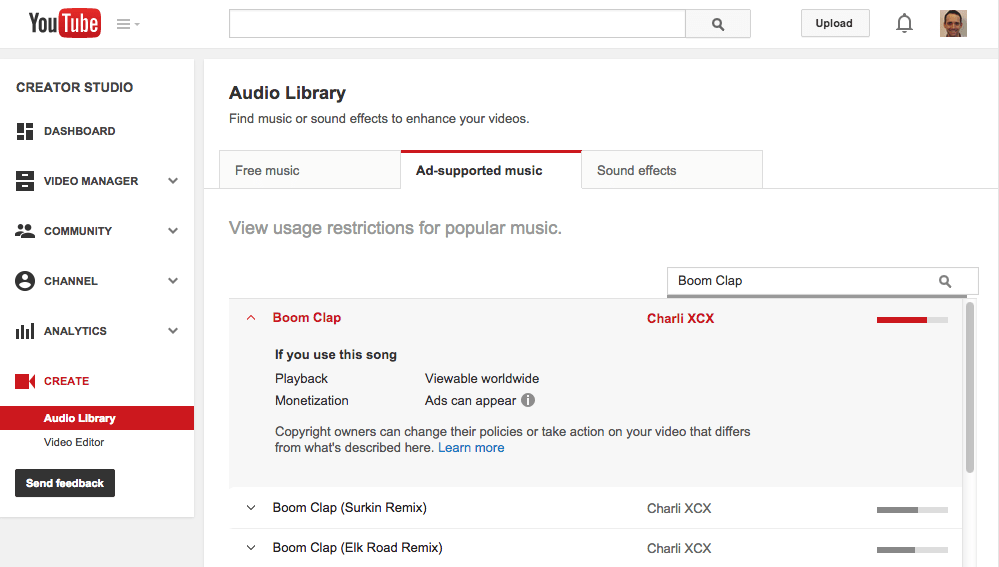
Google today launched a new feature in the YouTube Audio Library that allows uploaders who use copyrighted music to see exactly what will happen to their videos before they upload them.
When you upload a video to YouTube today, the service’s Content ID system will automatically try to figure out if you’re using any copyrighted music in it. Artists and labels can choose to then either mute that audio, block the video from being seen, or (if they’re smart) monetize the video by running ads against it. The problem with that is that until now, you didn’t know what would happen to your video until after you had uploaded it.


Using the new search feature in the Audio Library, you can now see exactly what will happen. Say you want to use Boom Clap from TechCrunch friend Charli XCX. You can now check and see that your video will still be viewable worldwide and that ads can appear on your video — but chances are you won’t be able to monetize your video through ads yourself.

This will definitely make life easier for YouTube’s content creators. It won’t solve any of YouTube’s issues around spurious takedown notices, but for the vast majority of uploaders, simply being able to check what a given song will do to a video is a major step forward. Once you’ve put a few hours into making a video — and maybe even synced it up with the music — finding out that your family won’t be able to re-watch its Thanksgiving antics on YouTube is a bit of a bummer.

YouTube also offers a large selection of royalty-free tracks for uploaders who want to monetize their videos.

Facebook Brings Graph Search To Mobile And Lets You Find Feed Posts By Keyword

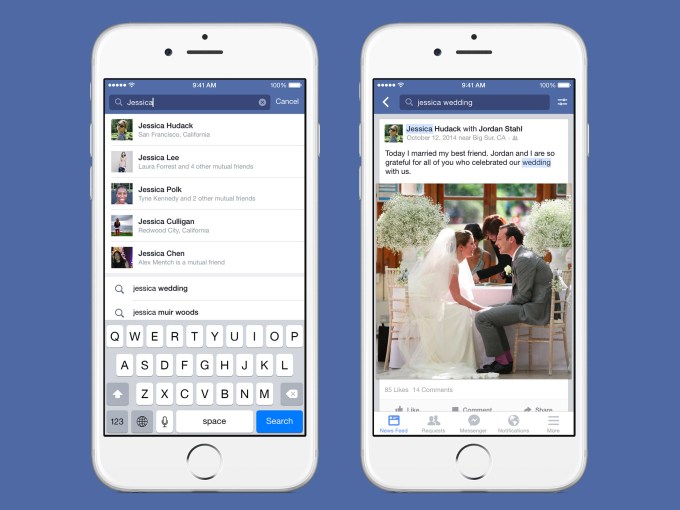
Facebook is finally getting serious about search. Today it’s challenging Google for finding answers and Twitter for checking real-time chatter with the launch of keyword search. Two years after debuting semantic “My friends who…” search for people, places, and photos on the web, Graph Search is rolling out on iOS in the US along with a new keyword search option for dredging up old News Feed posts by friends.


Check out my full hands-on review of the new Facebook Search

Product manager Rousseau Kazi tells me Facebook’s personalized search results are focused first on helping people rediscover thoughts, experiences, and memories they saw in feed. Still, queries for “dentist” or “burrito” could surface recommendations from friends that compete with Google results. Meanwhile, a search for “Michael Brown” or “101 traffic” could surface a feed of recent mentions or news articles by friends, similar to Twitter.

There will be no ads on Facebook’s mobile search or any new keyword ads. But since keywords can carry lucrative purchase intent, I’d bet Facebook experiments with ads here eventually to see if they could become real revenue generators. Businesses would surely be willing to pay to insert themselves into results for “restaurant” or “lawyer”.


Keyword search is a big step for Facebook because it indexes and unlocks content previously swept away by the rushing feed or buried deep in people’s profiles. “People want an accessible way to find these collective thoughts from the community” Kazi says.

That accessibility changes how “privacy by obscurity” effectively works on Facebook. Your privacy settings aren’t changing, and keyword search will only bring up content shared with you, like posts by friends or that friends commented on, not public posts or ones by Pages. But if a friend wanted to easily find posts where you said you were “drunk”, now they could. Users should take a look at their Timeline or search a few objectionable words with their name and use the in-line privacy selectors in the results to hide anything scandalous.

Kazi tells me eventually, Facebook plans to surface public posts as well, getting more of its un-Googleable walled garden indexed. And if you’re still not sure if Facebook could be a threat to the search giant, theses quotes from Kazi convinced me:

“Facebook has a wealth of information you can’t get anywhere else.”

“Every post is more or less an answer to a questions you didn’t know was being asked.”
A Shaky Third Pillar

When Facebook launched Graph Search in January 2013, Mark Zuckerberg hailed search as the third pillar of its product, alongside News Feed and Timeline. But Graph Search wasn’t quite living up to that title until now.

First, the semantic search engine was complicated. Rather than search with familiar keywords like on Google, you had to use complicated phrases like “My friends of friends who live near San Francisco and Like TechCrunch.” It was useful for finding what friends lived in a city you were visiting, or people who Liked a certain band and might want to come to a concert with you. There were niche use cases for recruiting, dating, or stalking (if you search for “Photos of [Name]” you’ll see photos they hid from their Timeline but didn’t untag), but there wasn’t much day-to-day need for it.


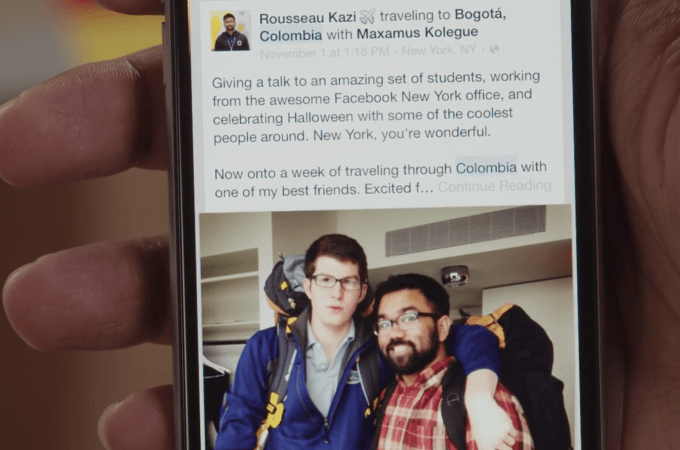
Facebook Search Product Manager Rousseau Kazi

A lot of people didn’t understand the semantic input method, Facebook still hasn’t figured out how to make it work in other languages, and all that typing is clumsy on mobile…or would be theoretically. Facebook said Graph Search would come to mobile in 2013 but is only just getting it out the door today.

Kazi admits that “Phrases are pretty complex”, but defends the slow progress, saying Facebook spent a ton of time with user experience researchers hunched over users brought into its lab to figure out what people wanted. The company also strengthened the core engineering behind Graph Search to make it easier to improve in the future.

Facebook’s research found people’s top requests were mobile access and post search, so that’s what it built.
How Keyword Graph Search Works

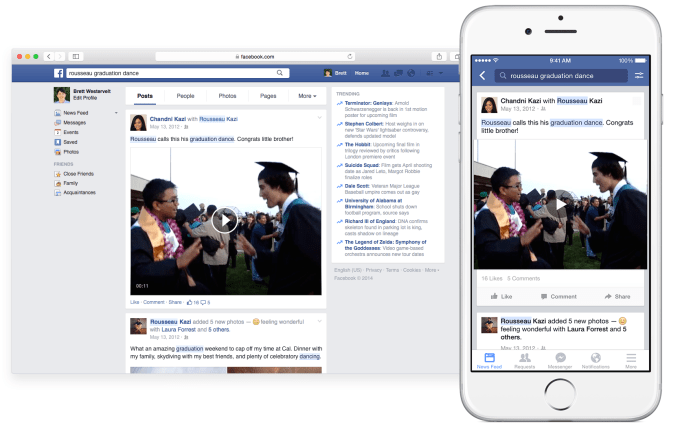
Facebook’s new search experience is coming to 100% of desktop and iOS users over the next few days, with a plan for Android once the kinks are worked out. You probably don’t have it just yet, though. You can still use the semantic search, but will also be able to punch in a keyword or several to find feed posts in your network that contain those words. For example, if you were my friend, you could search for “Josh Constine dancing” to see posts of me making a fool of myself.

The results are ranked with a personalization algorithm that combines the prevalence of keywords with a News Feed-style ranking based on how close you are with the author and loads of other signals. Posts show up in a feed design with the keywords highlighted blue, and spelling correction lends a hand. If the results are photos, you can browse them in an immersive photo-viewer interface.

The demo I saw of the new Facebook Search made it look snappy and intuitive. There are some filters for controlling what kinds of posts you see, though a true ‘advanced search’ option would be helpful. Facebook had plenty of opportunities to screw this up, but it looks satisfactory.


[Update: I’ve now received the rollout on mobile and am impressed by what post search can dig up. Here’s my full hands-on review.

I searched “Dentist” and it returned dozens of posts, including around seven nearby friends posting that they love their dentist, or asking for recommendations and getting comment reels full of them. I never remembered seeing any of these posts, but keyword search surfaced them to help me piggyback on what they know.

A search for “Ferguson” pulled up mentions by friends as recent as 45 minutes ago, and gave me a good look at the articles my friends are sharing about the Michael Brown tragedy. “Fun bar” found me some cool places to drink, but also showed me a fair amount of noise like post of “so fun to see my bestie” tagged at a bar. Overall, though, I was impressed by the utility of Facebook keyword search.]


Less Privacy By Obscurity

Only posts by friends or that friends have interacted with are eligible to show up in search. That means even if you posting something publicly, random strangers can’t necessarily find them. Some might want their posts to be discoverable like on open Twitter search. But once upon a time when Facebook was mostly just for college kids, people might have been much more cavalier about posting publicly.

Full public post search could lead to people unwittingly ending up embarassed or in the news because someone dug up one of their posts. Open search could drastically change “public” means as a privacy setting in ways people might not be comfortable with.


Kazy explains “it will be easier to find things you might have forgotten about. Anytime you make it easier to find information, that will be information that’s more likely to be seen.”

In a wise move, Facebook wil let you change the privacy of your own posts you find with keyword search, so it actually doubles as a privacy tool. Rather than having to scan back through your Timeline month by month, you could just punch in some racy terms and make sure you don’t return anything.
Facebook Omniscience

Beyond pulling up memories, keyword search could unlock the purchase intent that makes Google’s ads so valuable. And rather than relying on the feed or hashtags, Facebook could become a place to see what your friends are saying about a major world issue. It’s not the pulse of the whole world like Twitter, but a more intimate look at what your community thinks. Kazi notes “Giving people the abitiy to quickly tap into what friends are saying about a certain world is pretty powerful.”

Both these applications have plenty of room for improvement. It’d be great to see Facebook figure out how to aggregate posts or sentiment so rather than a feed of results, I got more explicit answers. If I search for “fun bar” or “dry cleaner”, Facebook could first tell me which are the most mentioned in my results. Instead of showing me the bar my best friend said was “fun” at the top, it could show the one 10 of my other friends all posted about with synonyms of “fun”.


As for taking on Twitter, the option to sort mentions of a keyword in reverse chronological order would be a big help. If I search “New York” right now, I’d like the ability to choose between recent posts by friends of news stories about the Eric Garner protests that shut down the big apple, and more evergreen recommendations of what to do there. Journalists like me and other exceptionally curious people would also love full public post search.

Of course, getting people to actually change their search behavior is harder than it sounds. Facebook Graph Search could already surface businesses you Like or checked-in at, and it didn’t make any noticible dent in Google for local business search. Facebook will need strong educational campaigns to burn the idea that it’s now a search engine into our heads.

Kazi concludes that “The grander search vision is we want to give you the ability to tap into the wisdom of your network and the world. This is one step towards that.”

Barack Obama Becomes The First President To Write Code

It’s official: Obama writes code.

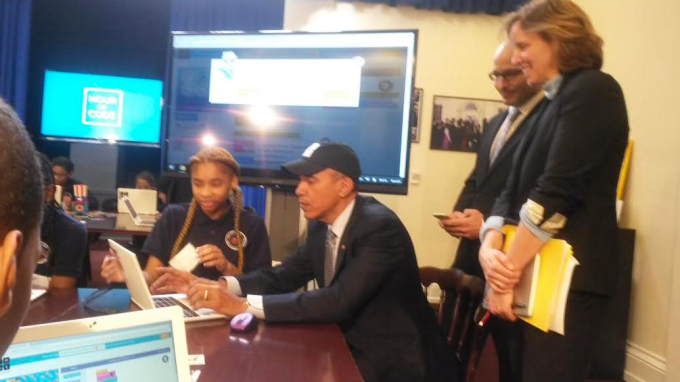
He probably won’t be up to debating the merits of Ruby vs. Python any time soon, but the President took the time to crack out a few lines of Javascript as part of the Hour Of Code — an event that encourages students to try just one hour of programming to see if it piques their interest.

While I imagine most TC readers don’t need to hear it, I’ll say it anyway: if you’ve never tried to code, try it! Even if you never intend to do it for a paycheck, learning even the most basic of basics can change the way you look at our increasingly digital world. You don’t have to dedicate your life to carpentry to learn to use a hammer.


Ready to dive in? Here’s Khan Academy’s intro tutorial for absolute beginners, specifically tailored to fit within one hour.

As for what the President coded up: he wrote a ranking algorithm that might just rival Larry and Sergey’s. Wait, sorry, wrong line — he wrote a little blurp of code that renders a square on the screen. Baby steps!

With Rumors Of Another Cellular-Capable Smartwatch, Let’s Hit The Brakes

OEMs, it’s time for a talk. I thought we could put this off for another few years, but it’s become apparent that, left to your own devices you’re not going to wait, so we’ll have to do this now.

When a smartphone company sees dwindling growth potential and increasing performance and feature parity across a range of connected phone devices, and when customers and companies used to love each other very much, but now seem to be growing apart, sometimes OEMs can panic and build something that they hope will reignite some passion, even though just below the surface it’s a very stupid idea.

That’s what’s happening with the Samsung Gear S, and what looks like it might happen with an LG G Watch R2, which is rumored for introduction at CES (via MobileSyrup) this year. Thepublication reporting its existence also predicted the Gear S citing the same sources, a device which shares the same trick of on-board cellular connectivity, though the G Watch R2 will also reportedly offer 4G, rather than just 3G connectivity.

Here’s an idea of how LG could better spend its time: Not doing that. I realize the terror that must keep OEM execs awake at night related to not missing the next big boat in tech, but smartphones on the wrist is not that boat – missing this “trend” is more like missing the swan that runs along a set track through 3 inches of muck and discarded cigarette butts at the Love Tunnel ride down by the boardwalk, rather than missing the Mayflower on its voyage to the New World.

Smartwatches with built-in phone powers are not new, and will never be cool. Even as companion devices I still think they have limited value, but making them smartphones as well actually adds an anti-feature: The need to secure and/or maintain a second cellular contract.

It’s still very possible this is just a baseless rumor, and LG will steer clear of this ‘nascent market.’ But there’s clearly something going round that’s giving some OEMs the idea it’s finally time for a watch phone to work. Please, take a step back and realize: It’s not that time.

Why Tech-Savvy CEOs Rule the World

Five reasons why technical skill translates into business results

It isn't hard to notice a trait shared by many founders of the world's most successful tech companies. Instagram's CEO Kevin Systrom was a self-taught programmer. Facebook's CEO Mark Zuckerberg began writing software before entering high school, and still keeps a hand in coding today.

Dropbox CEO Drew Houston wrote the first lines of code for his company from a Boston train station. WordPress co-founder (and founder/CEO of WordPress's parent company Automattic) Matt Mullenweg used his technical skill to help build the democratic publishing platform from the ground up.

Microsoft's Bill Gates, Amazon's Jeff Bezos, Google's Larry Page...the list goes on. Each of these leaders possessed a deep understanding of the technology that their business was built upon.

I believe this commonality is far more than just coincidence. Having technical chops as a C-level leader affords both you and your company many advantages over CEOs with a business-only background. Pairing tech savvy with exceptional vision and key leadership traits creates the perfect skillset to lead a tech-driven company--and even other companies that may not be considered tech-driven.

If the success stories above aren't enough to convince you, here are five more reasons why today's most successful CEOs are tech savvy:

Avoid the bubble. As the previously mentioned lineup of uber-successful leaders suggests, the best ones are those who really "get" their products--from the inside out. In a company's early stages, it's particularly beneficial to startups if the CEO is the one who maintains the closest link to the company's product. As Steve Blank said, "Startups are not just about the idea, they're about testing and implementing the idea." (His emphasis.) In order to do this, chief execs need strong technical skills, which provide them with more comprehensive knowledge about their company and improve their decision-making ability.

Many companies have leaders who the tech team would consider "suits": people with MBAs but no tech training. While these CEOs may be visionaries who excel in other areas of leadership, their lack of insight into the actual technology that underlies the business means that they live in a "bubble" of sorts. Leaders need hands-on appreciation of how to best leverage the technology along with the difficult issues that the company may face at different points in time during development. Without a firm grounding in this understanding, it's nearly impossible to make the best decisions.

To put a finer point on it: CEOs in the tech industry who lack familiarity with the inner workings of their own products may fail when it comes to making critical strategic decisions--ones that could determine the future of the entire enterprise.

I've experienced the flipside of this truism firsthand at my own company. My education in computer science and programming has greatly improved my decision-making ability at Pluralsight, which I've been able to draw on over the last decade of corporate growth. At start-up, my technical background allowed me (alongside our other founders) to author some of our company's first courses and help design both our website and our overall business model. Over time, this same background served me well when it came to identifying opportunities and quickly pivoting the entire business in a new direction (see below).

Gain the respect of your tech team. Tech-savvy CEOs have an easier time earning the trust of their technical group. You can't fake speaking the same language, and there's a certain authority and respect you can only command through knowing how to code. Personal experience with coding greases the wheels with everything from time management to delegation, because you know better what outcomes to expect. Asking your programming team to do things that you don't truly comprehend yourself is tantamount to trying to lead an army with no competency in military strategy.

Building rapport with your tech team is also an important component of creating a no-fear culture. When you as a leader understand the technical challenges that your company is trying to solve, you can empower your group to take the risks necessary to find creative solutions. By the same token, CEOs who lack tech expertise may quickly experience a disconnect with their developers. When you grasp your team's needs firsthand, it's a lot easier to create the type of work environment that can attract and hold onto top talent. In fact, gaining the respect of your tech team is an important precursor to effective recruiting, hiring, and retention.

Make smarter hires. As Kleiner Perkin's Mike Abbott said, "engineers close engineers." He should know, since while serving as VP of engineering at Twitter, he increased the company's engineering team from 80 people to more than 350. Because of the mutual respect that exists between engineers and a CEO who can talk tech from personal experience, tech-savvy leaders possess an indisputable advantage in attracting and retaining top tech talent.

For one thing, if you're a coder and programmer in your own right, it's much easier to identify the characteristics of stellar candidates. Since you know what you're looking for in your software developers and engineers, you can keep a hand in this part of the hiring process--which can be especially crucial at the startup stage. When you have the ability to explain the technical nuances of tech roles, it helps interest the best candidates in the positions.

Improve your ability to pivot. Tech-savvy founders have clearer vision, plain and simple. Their aptitude in tech empowers them in effectively identifying opportunities that someone without that experience wouldn't notice or know how to properly execute. Tech-inspired vision in leadership allows an organization to be more lean and flexible, to learn faster than competitors. It also helps increase insight into how to improve the flow of delivering value to customers, and facilitates quickly and radically pivoting the direction of your business when the right time comes.

As well-stated by Venkatesh Rao in Forbes: "[T]echnology changes suddenly expand the strategy canvas and offer new ways of doing old things, or entirely new things to do...The leaders who read the new game faster and better than competitors get ahead." In my own experience, having a technical understanding of my business facilitated my ability to know when it was time to transition Pluralsight entirely from classroom training to an online training model.

Improve resource allocation. A native understanding of what makes the most sense for the planning, design, and scheduling of software updates and product launches means that techy CEOs have an advantage in resource allocation as well. As Zuckerberg said in a recent interview: "So much of the infrastructure of what we do requires having good code and good abstractions, that actually being in there and seeing the work people are doing on a day to day basis gives us a much clearer sense of the investments we need to be making to run the company better."

In other words, when it comes to decision-making about the pipeline, tech-bred CEOs can fall back on their own experience to assess the feasibility of projects, goals, and timelines rather than being at the mercy of the opinions of those more in the know. This qualification can also bring a much clearer focus to illuminate exactly what you need to do to improve your business. Without a tech background, for example, it can be difficult for leaders to keep up with the constant changes in software updates, apps, and programming languages that can keep your company at the forefront of your industry (or cause you to lag behind). Tech-savvy leaders, on the other hand, can quickly analyze emerging technologies and decide which ones to adopt or reject. When shaping their company's strategic vision, they can also assess the potential impact of new systems on the market.

While a tech background is an important leadership skill, CEOs who come to the table with both technical and entrepreneurial expertise create a magical combination. Leaders who lack either tech skills or business and financial acumen will likely have a more difficult time maximizing their company's success. CEOs with expertise on the technical side, on the other hand, have an edge in helping to guide their companies to greatness in today's tech-driven world. This is true of all aspects of the business, from decision-making and resource allocation to vision and general management. Tech-savvy leaders can help their companies hire smarter, pivot faster, and ultimately lead better.
 

Another Data Breach, Another Dollar For Identity Management Startups

As security breaches are reported for one major corporation after another, venture investors are writing bigger checks than ever in an attempt to buy some peace of mind.
From Target’s data breach that put a damper on last year’s holiday season to Bebe’s payment card data breach reported last week, we’ve seen countless examples of access management gone wrong. It’s become apparent that the present identity management solutions are just not cutting it, and investors are fully aware.

According to CrunchBase data, identity management startups have seen $350 million in venture dollars raised this year across 45 rounds — a big step up from last year’s $178 million raised over the same number of deals.

Q2 saw a major investment push as some of the first massive deals in the space were recorded for startups like Okta, Centrify, and Dashlane.

“Every time there’s a breach at one of these companies, we’ve seen enormous damages as a result,” says David Cowan of Bessemer Venture Partners, a frequent investor in the identity and security space.

“For businesses like Kmart and JP Morgan, these breaches cost them hundreds of millions of dollars,” says Cowan, and for users, “they’re able to steal your password from a website that you think is irrelevant to your life, and it turns out that’s the same password to your bank account and your Dropbox.”

Cowan is on the board at Dashlane, a password manager and secure digital wallet for consumers. Dashlane’s recent $22 million Series B is one of the larger rounds seen by a consumer-focused identity management application. To date, the majority of venture dollars have gone into companies like Centrify or Okta that provide multi-platform access management solutions for enterprise customers.

“When companies controlled all their systems on premise, everybody had a username and a password into those systems,” explains Robin Vasan of Mayfield Fund, an early Centrify backer, “but now with mobile devices and SaaS applications, those systems are no longer in control.”

“Identity management has seen such a resurgence of interest because enterprises are realizing that an employee of theirs goes and buys a new mobile device or is using a laptop from home and is accessing cloud applications, and those resources are no longer under the control of the enterprise,” says Vasan.

Centrify and others are tackling this issue by providing enterprises with secure identity management and single sign-on services that allow employees to access cloud-based applications across multiple devices.

Venture funding front-runner Okta will let you into all related apps with a single login, and five-year-old Dashlane will remember all of your passwords for you. But recently startups like Nymi and EyeVerify have closed sizable deals to replace passwords completely with biometric technology.

“People lump in together the identity management, access management, permissions and authentications — and we’re all about decoupling that,” says Nymi founder Karl Martin. “There’s a simple philosophy around privacy — a system should only know as much about you as it needs to for that application.”

Nymi seeks to accomplish this through a wristband that identifies a user by their unique electrocardiogram signal and acts as a gateway to provide easy authentication for a number of applications.

“Biometrics are a very useful tool for identity management, but the danger there is that you’re collecting a massive database of biometrics, and that has many implications for security and privacy,” says Martin. It’s a legitimate concern — the idea of handing over more personal data to protect the data that’s already out there seems a bit backward at first.

But Nymi isn’t collecting or storing any of this data. “It’s not verifying who you are, just that you’re the same person that showed up before,” says Martin of the Nymi band. “We’re not actually managing your identity — that should be application specific, and you shouldn’t have all of your information in one place.”

Nymi has locked down a variety of partnerships, from password manager PasswordBox to MasterCard, and is in the process of closing more deals to become something like the single sign on for the world.

“I don’t think anybody has a sense that we have actually good solutions in operation now, there’s absolutely a need for new technology,” says Martin. “On the one side it’s kind of crazy what we’re doing, but on the other side, do you imagine ten years from now that we’ll still be using passwords?”

Samsung Gear VR Launches Today For $199 Dollars

Anyone with a Samsung Galaxy Note 4 can take a dip into virtual reality today with the launch of the Samsung Gear VR Innovator Edition.
For an entry fee of $199 on Samsung’s or AT&T’s sites, you can experience a variety of VR experiences on an included 16 GB MicroSD card starter kit as well as the Oculus store. At the time of writing Samsung hasn’t confirmed whether or not you’ll be able to get all of the card’s content on the Oculus store, so if you’ve expanded your phone’s storage with a card of your own you may have to do some swapping on occasion.

Those who already own the most recent Oculus Rift developer kit will notice a few big differences when they strap on the Gear VR. Because the screen is a Galaxy Note 4 you attach to the headset, you’ve got a 1440p screen rather than 1080p. That means the so-called “screen door” effect, where you can see the pixels on your screen because they’re so close to your eyes, won’t be quite as distinct with this headset.

The new screen does come with a bit of a trade off, however. The Galaxy Note 3 screen in Oculus’ second dev kit is set to refresh 75 times per second. The Note 4 can only handle 60, which means that you’re slightly more likely to experience some nausea as you spend time in VR.

Because the Gear VR is made to be mobile, Samsung can’t rely on a persistent external camera to track your position in space while you where it. This means you’re not going to be able to play the kinds of games built for Oculus that let you interact by moving your body — say, leaning around to fly a ship or dodge bullets — as the gyroscopes can only really check the angle of your head.

Samsung partially makes up for that with the inclusion of a Bluetooth controller (with “standard” video game controls, i.e. a directional pad, action buttons, and shoulder buttons) in a $249 bundle that’s also available today. That’ll give you full control of some of the more in-depth interactive experiences that will be available through the Oculus content hub, including a few games at launch.

That’s not to say you’ll need to break out the controller every time you slot your phone into Samsung’s headset. Unlike the current Oculus dev kit, the Gear VR has a touchpad built into the side of the headset that controls like that on Google Glass: swipes for navigation and taps for selection.

Those hoping to get lost in virtual reality with the Gear VR should temper their expectations. Based on the hand-on time I got with the device at Samsung’s developer conference a few weeks back, many of the experiences built thus far for the device are intentionally short, taking somewhere between 1-10 minutes each. That’s actually more of a pro than a con, as it keeps you from getting too uncomfortable from any individual experience.

Michael Arrington of TechCrunch: The Way I Work

TechCrunch, a San Francisco-based company that publishes the influential blog of the same name, started as a hobby. In 2005, Michael Arrington, a serial entrepreneur and former lawyer, was researching Silicon Valley start-ups and decided to post his findings online. Since then, TechCrunch, which draws about 9.2 million visitors a month and boasts annual revenue of about $10 million, has become the go-to source for breaking news about Internet start-ups and tech companies. Although TechCrunch has 25 full-time employees, Arrington, 40, still spends much of his time reporting and writing. On most days, he works remotely from his home near Seattle, in a cavelike home office. From morning until night, Arrington sits in darkness in front of his computer—blasting music, working his contacts, and focusing on what he loves best: breaking big stories.

I wake up in a pissed-off mood. I'm not a morning person. And I usually wake up to emergencies—an e-mail or a text message saying, 'Oh, my God! Something big is happening! How could you not have written about this yet?'

If news is breaking, I want to be on it. We break more big stories than everyone else combined in tech—and that's not prebriefed news or something that was handed to us. I judge my own performance based on that. When we break a story, that's a point. When someone else breaks a story, we're minus a point. And I want to be positive points.

I try to get up at 9 a.m. every day. One of the things my doctor wants me to do is regulate my sleep. A year ago, I'd work until I passed out, and wake up eight or nine hours later, which might be 4 p.m. or 3 a.m. Then I'd work again until I passed out. That was my life for four years—it got really bad. I missed a lot of social things. I didn't keep up with friends. I was a mess. I actually gained 50 pounds in the five years since I started TechCrunch. So now I'm working with a doctor and trying to get reset. Getting up at the same time every day is apparently one of the best things you can do health-wise. The problem is, I still don't go to sleep very early. So I'm usually working on four or five hours of sleep. Then I make it up on the weekends.

The very first thing I do in the morning is go right to my computer, which is always on. I'll scan my e-mail for breaking news. If something big is going on, I'll decide if I want to cover the story or assign it to another writer. Say a source sends me a tip that Google is buying Microsoft, and it's going to break later today—I'm making this up, but that would be a big story. I'd start calling people at Google and Microsoft to see if it's true or not.

Sometimes, it will be true, but the company will ask me to hold off. Negotiating with companies over how news breaks is a big part of what we do. I don't think traditional journalists would do this or admit to it, but a source might say, 'Yeah, we just got bought, but can you please not write about it for a week, because it might kill the deal?' Unless I know lots of other journalists are sniffing around, I generally defer to the entrepreneur. We probably lose half of those stories, but it's the right thing to do. It builds trust. People aren't going to tell you things if they don't trust you.

Usually around 11 a.m., after I have put out all the fires and there's nothing left in my inbox that I have to address immediately, I'll take a shower, get dressed, and walk my dogs. I have a chocolate and a yellow lab, and they're my best friends.

I moved to the Seattle area in May. It's calm, and my parents live nearby, so I see them a few times each week. I spend two-thirds of the time working here, and the rest of the time in our office in San Francisco. Right now, I don't actually have a place in California, so I stay in hotels.

After my dogs are fed, I make myself something to eat and go back to my desk. My office is like a cave. I have blackout shades on the windows. I like the dark. There's less distraction. I use a Mac with two 24-inch monitors, and I'll do research on one screen and write on the other. It's more efficient. I'd love to have three monitors, but Macs support only two. I have the exact same setup in my office in San Francisco.

I usually spend about half my day talking to sources, either on the phone or on IM. There are very few people in Silicon Valley—or in tech, in general—whom I don't know pretty well. Chasing down stories is my favorite part of my job. My style is to bust the door down and clean the mess up later. That works pretty well for me. I've known a lot of my sources for five years now. When I call them, there's no salutation—it's just right to the point. I expect them to tell me what I want to know very quickly.

Our main competitive advantage is that my team and I truly love entrepreneurs. They're my rock stars. I've always been fascinated by entrepreneurs. I had four businesses that did not work out. TechCrunch is my first real success, and it happened by accident. If I were to write a book, it would be about what drives entrepreneurs. I meet the winners, and the losers, too. Most of them could go out and get a perfectly reasonable job as an accountant or a lawyer. Instead, they risk everything for almost certain failure. The losers are actually more interesting sometimes. You learn a ton from failure.

I never develop friendships with people I don't actually like. For instance, I write about digital music a lot. And the music labels are notorious for working the press. They'll leak stuff and develop relationships, and it can actually be pretty fruitful as a journalist to get to know them. I hate 'em. They sue their customers. I see them as Darth Vader. Maybe it's not fair, but I see the world in black and white. I don't like them, so I won't talk to them. My sources are all people I actually genuinely like, and I think they know that. They're my friends, too.

I'm pretty unorganized when it comes to keeping track of my sources. I used to keep most of them sorted in my head. But then at some point in the past year, I suddenly lost my short-term memory. I don't know if it's just turning 40. One way I stay organized now is by using Google Voice. It keeps a record of all of my phone calls and text messages. When I make a call, I'll almost always initiate it from my computer through this service. And if somebody calls my Google Voice number, it will ring my cell phone or my home phone—any phone I want. It also makes it easy to set up cell phones when I travel to Europe or Asia.

Text messages and phone calls tend to be the sort of cloak-and-dagger way I get tips and story ideas, but I also use Skype a lot. The video quality is great. When you go full screen, it's like the other person is in the room. Skype also has screen sharing, so the person can hit a button and I can see their desktop. I use it a lot for business, and more and more for talking with friends.

I don't like PR people for the most part. I like going to CEOs directly. If a PR person suggests I meet the CEO of this new company, I always say yes. But if they say, 'Can we set up drinks? Or dinner?' I say no. I hate that—it is a huge waste of time. Let's meet over coffee or get on Skype video and talk about your company, but I don't want to chitchat about your family, because I don't know you. If I have time to go to dinner, I want to do that with my college friends or my parents or whomever I'm dating.

I usually post several times a week. When I first started TechCrunch, I would post several times a day. I've always been manic about it. You know that experiment where the rat hits the lever and the treat comes out? By the third day of writing, I got my first comment from somebody who wasn't my mom. That's the treat. Then people started subscribing to my RSS feed. Every day, that number would go up—10, 13, 100. That constant feedback is my reward. I still scan for comments on my posts. I can almost always predict how many comments I'll get. Most are knee-jerk reactions, but sometimes there will be a few that are worthy of discussion, and I'll chime in.

TechCrunch is known for our parties. That's how I met all my sources in the early days. These days, we do three big blowouts every year, five or six smaller events, and then a few small parties. It winds up being an event every month, and I try to go to all of them. I started the tradition when I first moved to Palo Alto in 2005. I wrote a blog post inviting people to a party—10 people came. I made hamburgers. We drank beer and stayed up until 4 a.m. drinking Scotch by the fire. Two weeks later, I had another party, and 20 people showed up. About 100 people came to the next one, then 200. Venture capitalists were smoking pot in my backyard and passing out on my couch. I stopped having parties at my house, because it was getting trashed. About 1,000 people came to our party this summer.

Over the years, some people got upset when we didn't cover them, and a certain percentage of those really made it personal. Or I'd write about how much I liked a start-up—or didn't like a start-up—and people would get really passionate about that. Suddenly, there were people who really didn't like me. And because I'm introverted—I like being alone—that actually made me pull in a little bit, and then more and more. The more I pulled in and stopped talking to people, the more people saw me maybe as arrogant.

So suddenly, I have all these enemies. In 2008, somebody spit on me at a conference in Germany. Before that, I had a death-threat incident—I had to hire private security 24/7 to protect me and my parents. We closed our office, and one of our employees got detained by police when he stopped by to check on things. Obviously, we sorted that out, but the whole experience freaked me out. I took off. I went to Hawaii for a month and didn't bring my computer. Page views went up; everything was fine. That helped me realize that I am not nearly as important as I thought I was—and that the team I hired is really good. I've really let go since then. Now I really rely on them, and it's really good.

I have never been very good at managing. I want to be writing, and it's hard to be a coach and a player at the same time. Plus, I'm moody. That's why I hired Heather Harde as CEO. She is steady. Erick Schonfeld, who is co-editor of TechCrunch, manages the editorial team. I talk with each of them maybe three times a week. We have never had an executive meeting. Instead, we use this program called Yammer to make sure everyone at TechCrunch is on the same page. It's like a streaming bulletin board—anyone can post, and everyone will see it. If I think a writer or editor did a great job, I'll give them a public high-five. Or if someone screwed up the formatting, I may point it out so others can learn from those mistakes.

Around 3 p.m., I usually take a break. I run errands or play fetch with my dogs. This summer, since I'd just moved, I did a lot of household things—like unpacking or buying a shower rod. Depending on my plans, I may go out to dinner with my friends or my parents. Or I'll eat alone and then go back to work. Honestly, my goal these days is fitting real life in around the work.

After dinner, I'm usually back at the computer. That's when I do thought and opinion pieces. I'll spend two or three hours on one post. For example, in July, a CNN journalist was fired for tweeting her opinion about a Hezbollah leader. I wrote a piece about how ridiculous it was that she could not have an opinion.

I like working late at night. There are no interruptions. I usually listen to music when I write. I like hard music that is not happy music—Metallica, Eminem, Rage Against the Machine.

I might go until midnight or 6 in the morning. No matter what time it is, I always read before I go to bed—even if it is only a few pages. Usually fiction and always an actual printed book. My favorite book is Catch-22. And then I fall asleep, happy.
 

In $86B Of Online Media Sales In H1, Google Leads, Chinese Sites Grow, And Ads Take Lion’s Share

Strategy Analytics has today published its rundown of how online media revenues performed in the first half of 2014 — looking specifically at how 44 of the biggest publicly-listed companies fared the first half of this year. Altogether this group pulled in $85.9 billion in digital media revenues in the first half of 2014, a rise of 17% on the same period a year ago. And, perhaps unsurprisingly, search engine giant Google continues to be
the very biggest player online, collecting $31.4 million in sales in the period on the strength of its ad business.

To give you some context for what Google’s number means, it is more than one-third of the total value of all the online revenue generated by all 44 businesses, and nearly as much as the rest of the top-ten list totalled up. E-commerce giant Amazon came in at number-two with $10.3 billion.

Other top-line conclusions: China’s online businesses are still far smaller but they are growing, and fast, taking up 4 of the top-10 slots. Yahoo is still ranking in the top list with $2.2 billion in sales but is also the only one that declined (down 3%). And although games and other digital content is growing, advertising is still the biggest revenue generator by a large margin.

Google’s growth at the moment, Strategy Analytics says, was 12%, putting it ahead of Amazon’s 9% growth but very far behind some of the smaller juggernauts. Specifically, Facebook’s $5.4 billion in online revenues for H1 were a whopping 66% up on a year ago.

That put FB at a faster pace of growth at the moment than some of the bigger Chinese sites: Tencent pulled in $5.4 billion (up 43%), while China’s Google equivalent Baidu posted $3.4 billion, up 56%. Sina was up 36%.

As you would expect with more up-and-coming services, there were smaller players that grew even faster, though.

Chinese internet security software firm Qihoo, it says, was the biggest growth story, with its $582 million in online revenues a rise of 123%. Twitter’s $562 million was up 122%.

“A red-hot Chinese Internet market is challenging the historical dominance of US companies,” writes Michael Goodman, Director, Digital Media for Strategy Analytics. “The fact that there are about 2.5x more Chinese than Americans online is a big factor so they’ve been able to hit such heights solely in a domestic market. The big question, and the key threat to US global dominance, is whether they can translate this success outside China.”

It doesn’t note growth for Apple’s iTunes but points out that its first half sales were $5.2 billion. Apple, of course, is the world’s biggest tech company today in terms of market cap, and most of its revenues come from hardware sales, not online content. Also, notably Alibaba is not in the mix, presumably because there are no public numbers to use for comparison.

Yahoo is the only one of the world’s top 10 to see digital media revenues decline year-on-year (down 3%).


In terms of what is doing well online, although we have seen an explosion of digital content services, ads are still the big money maker. Online ads accounted for 77% of all digital media revenues, followed by online games (15%) and video (5%).

“Music and content delivery networks (the latter such as Akamai and Limelight who serve content on behalf of publishers) split the remaining 3%,” it notes. Games are the fastest riser, up 26%, but ads and video are not too far behind at 24%. Content delivery networks grew revenues by 21% while music didn’t do very well at all, up by only 9% (not a great sign for the Spotify’s and Soundcloud’s of the world).


What will be worth watching is how well ad companies — and really all online companies — diversify in the future. SA notes that 100% of Baidu’s and Microsoft’s Online Services revenue came from advertising, while Facebook attributed 91% to ads. Google makes 90% of its online revenues from ads, while Yahoo makes 80% (60% for Yahoo Japan, which also has a broadband service). “Music streamer Pandora also relies heavily on advertising accounting for over three-quarters (77%) of revenues,” it notes — a sign of how it manages to creep into that top-ten list despite music’s otherwise lacklustre performance.

SA notes that China’s firms are more diversified than those in the west.

“The Chinese companies have been particularly adept at generating revenues across a variety of services,” Goodman writes. “The fastest mover, Qihoo, for example has done well in both advertising and Internet value-added services, driven by expansion into search and mobile.” This is not always the case, of course — witness Baidu’s 100% ad-based revenue model.

Diversification potentially also underscores why companies like Amazon are moving so aggressively into a range of services, from content to advertising to delivery to hosting to private label goods, to complement its e-commerce operations.

Iran: Country Developing System To Identify Any Internet User

The government of Iran is no stranger to using its power to restrict Internet freedoms in its country, blocking millions of websites when they have run counter to religious or political beliefs. Now it sounds like it plans to take that another step further: engineers are developing a system to identify any individual in the country who goes online, according to a report in the AFP (via Yahoo News),
citing comments made to the semi-official Iranian Students’ News Agency.

“In future when people want to use the Internet they will be identified, and there will be no web surfer whose identity we do not know,” the country’s minister of telecommunications Mahmoud Vaezi was quoted as saying.

He did not provide further details about how this would work, or the timing for when this system would be turned on.

We have been trying to find the original source material the AFP is reporting on. We have also contacted the ISNA for more detail. So far, no dice.

The idea with IDing users seems to be that by doing so, it will deter them from posting or reading contentious material by making it impossible to do so anonymously. It comes alongside wider plans to introduce filtering services to identify and block offensive content.

The smart filtering services would be rolled out in phases, with levels of service being turned on in one, three and six months. From the looks of it, the filtering appears to be a system that will detect and block out portions of websites that are deemed criminal (in the eyes of Iranian authorities) without blocking the full site. The full project is expected to be completed in 10 months.

This is not the first time that Iran has been in the news for technology to ID users.

In 2012, Iranian authorities were reportedly testing a service that would be used in public places, specifically venues like Internet cafes (a popular way of going online in Iran, where about 30 million of its 75 million citizens use the Internet), that would require users to log in to use services.

Perhaps bowing to international pressure, Iran has in the past denied that it was working on such services, although it has, ultimately, continued to work on ways to restrict Internet access.

Among the millions of sites that are regularly blocked for hosting politically or religiously contentious content are Google, YouTube, Twitter, Facebook and most recently WhatsApp and other communications apps like Viber and Tango.

Internationally, the country has been more notorious for allegedly hosting and supporting hackers who have carried out infrastructure attacks in opposition to Stuxnet and spreading malware, with the aim of disrupting services thought to be supportive of the U.S. or Israel — claims the country has denied.

Updated with more background information, links.

Chris Hughes: Facebook Co-Founder Defends His Approach At The New Republic

The New Republic, the political magazine that was purchased by Facebook co-founder Chris Hughes a couple of years ago, has seen resignations from numerous writers and editors in the past couple of days — from the outside, it looks like another clash between the values of tech entrepreneurs and traditional journalism.

The exodus was spurred by the departure of New Republic editor Franklin Foer and longtime literary editor Leon Wieseltier, but it sounds like tension has been building for a while. For example, The Daily Beast heard about a recent meeting where new CEO Guy Vidra (formerly of Yahoo News) alienated senior staffers by offering nothing but “Silicon Valley jargon.”

Now Hughes has written an op-ed for the Washington Post in which he lays out his perspective. (The Post, incidentally, was also acquired recently by a tech executive.)

Hughes argues that portraying the dispute as a case of “Silicon Valley versus tradition … dangerously oversimplifies a debate many journalistic institutions are having today.” He doesn’t get specific about what happened here, or about his plans for the future, but he does say he wants to create “a sustainable business” that’s not just going “to chase traffic with listicles and slide shows.” Experimentation and change, he writes, are a key part of that process.

(Departing editor Julia Ioffe predicted earlier that Hughes and Verda would paint their detractors as “dinosaurs, who think that the Internet is scary and that Buzzfeed is a slur.” But she said that on the contrary, the staff was “not afraid of change” and has “always embraced it.”)

Fairly or not, the story’s been slotted into the broader narrative about the tech world and journalism, so it’s also interesting how Hughes claims not to fit into the Silicon Valley mold:

I’ve never bought into the Silicon Valley outlook that technological progress is pre-ordained or good for everyone. I don’t share the unbridled, Panglossian optimism and casual disdain for established institutions and tradition of many technologists. New technologies and start-ups excite and animate me, but they don’t always make our lives or institutions better.

I suppose we’ll get a clearer sense of Hughes’ vision for the new New Republic when it publishes its next issue in early 2015.

Alibaba: Alipay Now Sees Over Half Of Its Transactions In China From Mobile Devices

China is in the midst of a mobile commerce boom, according to a new report from Alipay, the Alibaba-affiliated payments service that handles more than 80 million transactions per day.

The company‘s latest report found that 54 percent of the number of transactions on its PayPal-like service during the first ten months of 2014 were from mobile devices.
That’s a huge increase on last year, during which mobile accounted for just 22 percent of all payments.

This year saw mobile internet access overtake desktop access for the first time in China, but interestingly Alipay — which has over 300 million registered users and more 190 million downloads of its wallet app — found differing behavior when comparing urban and rural parts of the country.

Mobile payments were relatively low in affluent cities like Beijing, Shanghai, and Guangdong (accounting for 29 percent, 24 percent and 27 percent of transactions respectively), but in more remote areas like Tibet, Shaanxi and Ningxia, mobile accounted for 62 percent, 60 percent and 58 percent of transactions respectively.

While consumer spend in these mobile-focused provinces clocked incredible growth — it was up 600 times and 145 times in Tibetan cities Lhoka and Shigatse — more than 55 percent of Alipay’s total transactions came from five of China’s most developed provinces: Guangdong, Zhejiang, Jiangsu, Shanghai and Beijing.

Indeed, the highlight figures account for the sheer numbers of transactions. When it comes to the overall volume of sales processed via mobile, the figure is almost certainly below 50 percent. Mobile accounted for 43 percent of the record $9.3 billion sold on Singles’ Day 2014, which may be higher than usual given the amount of promotion and hype behind the event.

Smartphone shipments are slowing in China as adoption of devices nears saturation point in urban areas, and that is coaxing China’s largest tech firms into addressing the technology gap in rural areas. Tencent, for example, last week showcased its first ‘mobile internet village’ in China aimed at bringing new citizens online.

In one example of the program, the company is providing smartphones and free WiFi for 460 households in the Tongguan village in Guizhou province in Southwest China.

Affordable mid- and low-range phones have propelled Xiaomi to number one in China’s smartphone rankings, and third worldwide, while also emphasizing that China’s next smartphone boom will come at the lower-end of the price scale as technology reaches new demographics.

There’s huge potential in that connectivity. A short Alibaba documentary shows how smartphones can provide access to a more varied selection of products and unearth business opportunities in more remote areas where there are fewer retailers and limited access to supplies.

Alibaba does, of course, have a vested interest in telling this story, since its Taobao and Tmall marketplaces are the primary e-commerce options in China — indeed we highlighted the importance of both mobile and less developed cities for Alibaba following this year’s Singles’ Day. Nonetheless, the core findings of Alipay’s report make for interesting reading into how the dynamics of China’s tech space are shifting as mobile internet access grows.